Lookalike - Scaling Marketing Campaign Forecasting with Generative AI
Business Context
Before a campaign ever reaches guests, marketers need to decide how much to invest in it. A reliable way to forecast a new campaign is to find “lookalike” campaigns from the past, ones with a similar product domain, audience, and timing, and use their performance as a reference.
The previous system relied on rule-based logic and basic embeddings. It worked for the campaign types it was designed around but struggled with niche campaigns, which led to false positives and frequent manual triage. Partners also needed results they could audit, explain, and tune.
Our Goal
Automate lookalike campaign matching so that every new campaign gets at least one strong, explainable historical match without human override.
Solution Overview
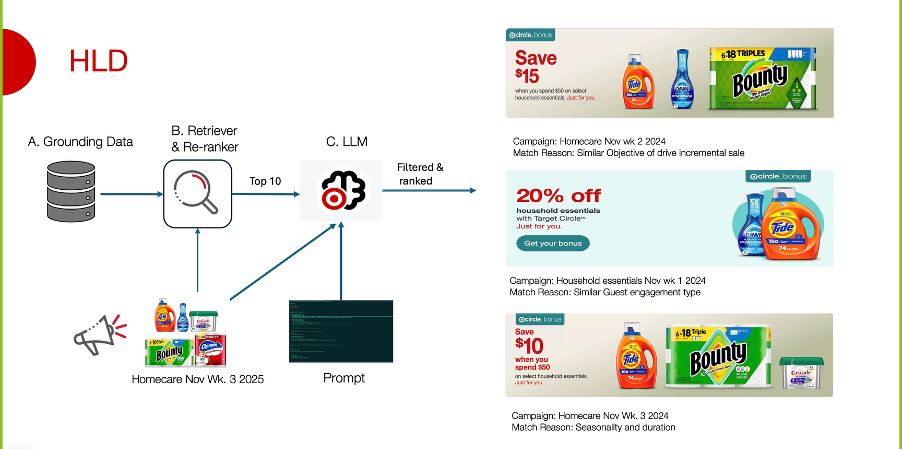
Lookalike treats each new campaign request (markdown, guest intent such as engaged or lapsing, categories, and other metadata) as a query and answers it with a retrieval-augmented generation (RAG) pipeline:
- Data preparation: Historical campaign and offer data is unified, filtered, and enriched into one consistent offer pool. Engineered features include distribution volume, redemption counts, total discount spend, and governance indicators (sitewide vs. targeted, mass vs. niche).
- Embedding & indexing: The offer pool is embedded with language models and indexed in Target’s in-house AI grounding service. A multi-index approach gave the best raw retrieval quality.
- Retrieval & re-ranking: A retriever and re-ranker produce a candidate pool of the top N historical campaigns.
- LLM filtering & ranking: A structured prompt gives the LLM the campaign facts, the retrieved candidates, and a matching-criteria hierarchy (product domain → audience segment → timing). The LLM returns a ranked set of matches with a rationale for each.
- Validation layer: An extra validation step guards against LLM hallucination before results reach marketers.
Results
The primary metric is coverage rate: how often the system returns at least one acceptable recommendation without human override. It was measured on a time-separated train/test split of diverse recent campaigns.
- K=1: 75% coverage
- K=3: 100% coverage. Every campaign had at least one strong match.
- Eliminated up to 8 manual hours per campaign of triage.
Impact & Recognition
- Explainability: Every match comes with an LLM-generated rationale that marketers can audit.
- Robustness: Handles niche campaign types that broke the previous rule-based system.
- Publication: Featured on Target Tech Blog (2026)
This project brings production GenAI and RAG to marketing campaign forecasting. Read the full blog post for more details!